How to Make a Vision Board That Works
Ask a child what they want and they'll rhyme off their Santa list in seconds. Ask an adult the same question and things get a lot quieter.
Somewhere along the way, life gets busy. Stress, responsibilities and everyone else's needs start to cloud our vision for what we want. That's exactly why a vision board is so powerful. It's a tool for getting clear and staying focused, and it helps you answer one simple but life-changing question: What do I want?
But not every vision board works. A pretty collage that sits behind a door won't change your year. A vision board made with intention, step by step, absolutely can.
Here's the exact 5-step process I use with the people I guide, so you can create a vision board that actually works.
Would you rather be guided through these steps live? Join me for a virtual vision board workshop
What is a vision board?
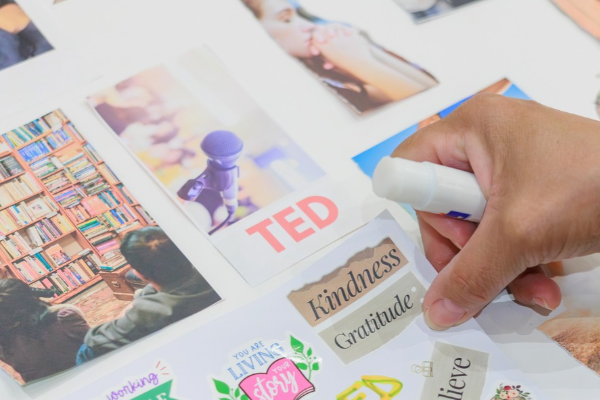
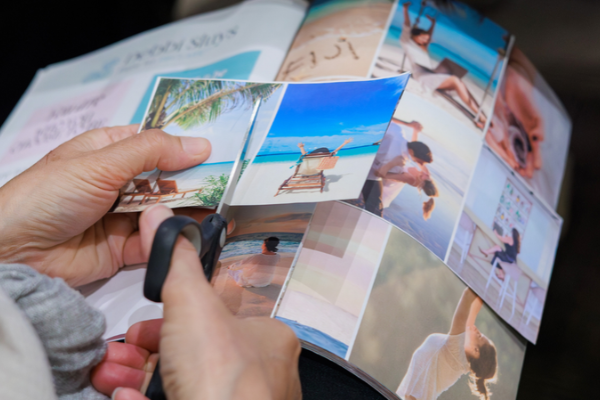
A vision board is a collection of images and words, arranged on a board you see every day, that represents what you want your life to look and feel like. It is not an arts and crafts project, and it is not magic. It is a clarity tool. Your board takes the goals that live vaguely in the back of your mind and puts them in front of your eyes, multiple times a day, every day, so your focus, your decisions and your daily actions start lining up behind them.
People make vision boards for all kinds of goals: a business they want to grow, a home, better health, travel, relationships, money, and the person they want to become along the way. The board works because of what it does to your attention. What you look at daily, you move toward.
What you'll need
- 20x30 foam core board
- Images: [Read Where to Find Vision Board Pictures]
- Scissors
- Glue Stick (in my workshops we glue, never pin, and you'll see why in Step 3)
- A photo of yourself from a happy time
How to make a vision board in 5 steps
Step 1: Dream (get clear on what you want)
Before you touch a single image, you need to know what you want. This is the step most people skip, and it's the one that matters most.
In my Dare to Declare™ Vision Board workshops, I pair participants up for a simple but powerful exercise. For 30 seconds at a time, one person asks, "What do you want?" over and over, and the other answers with something new each time. Then they switch. It's always surprising what rises to the surface when you give yourself space to answer honestly.
As you dream, think about these seven key areas of life:
Professional and career
Personal and health
Leisure
Education
Financial and contribution
Relationships
Spiritual
Some areas will feel easy. Others may take more thought, and that's okay. There's no right or wrong answer. Write down whatever comes up, even if it isn't fully clear yet. Point form is perfect.
For example, under Spiritual you might simply write: Pray more. The what, where and how don't matter right now. Just write down BIG visions for every area of your life.
If you'd like to go deeper, tools like personality tests can offer helpful insight as you explore your purpose.
This exercise is even more powerful in a room. In my virtual vision board workshops, we do the "What do you want?" exercise together, plus several more clarity exercises, before anyone touches an image. Save your spot in an upcoming workshop
Step 2: Dig (find images that represent your goals)
Now it's time to find images that represent your vision. Choose pictures large enough that your board can be seen from across the room, and go big. The size of your board says something too. It represents a BOLD vision.
As you find your images, watch out for two common traps.
Don't confuse a "how" with a vision. Say you want a calm, peaceful bedroom. Most of us would reach for a picture of a tidy closet or a storage system. But organizing is the how. Instead, choose an image that captures the feeling you want in that serene, peaceful room.
Watch out for "shoulds." FEEL each image. Does it feel good? If it carries any sense of "I really should do this," it doesn't belong on your board.
I once coached a woman who felt she "should" go back to school. She compared it to a gambler on a losing streak who keeps putting in more money because he's already lost so much. So I asked her the same question we started with: What do you want? If she wanted a degree because she had a passion to teach, then going back to school made perfect sense. But if she only wanted it because she'd always said she would, it might be time to rethink that goal.
Here's a question that cuts through the noise: if you only had a year to live, what would your vision be?
Need help finding images? Read Where to Find Vision Board Pictures.
Skip the hunt for images. The Dare to Declare Vision Board Magazine has more than 300 images ready to cut, plus a QR code to my full Vision Board Workshop. Get your copy on Amazon.
Step 3: Discover (edit and arrange)
Just like with our homes and our lives, it's good to edit. For every image, ask yourself, "Does this serve me?" Feel it. Is it truly a priority?
A vision board is very different from a never-ending Pinterest board. It has borders and limited space, and that's a good thing. In my workshops, I always recommend giving each image breathing room. That means your images don't overlap and there's white space around each one, so your eye can rest between them. When you focus with intent on each image, you honour it, and you give your subconscious mind room to do its magic.
As you arrange your board, keep these in mind:
Feel your choices as you place each image.
Add a photo of yourself from a happy time, and place it somewhere prominent.
Include your Power Word if you have one.
Choose your fonts carefully. Fonts carry a feeling too.
Glue, don't pin. Adhering your images to the board is a commitment to them.
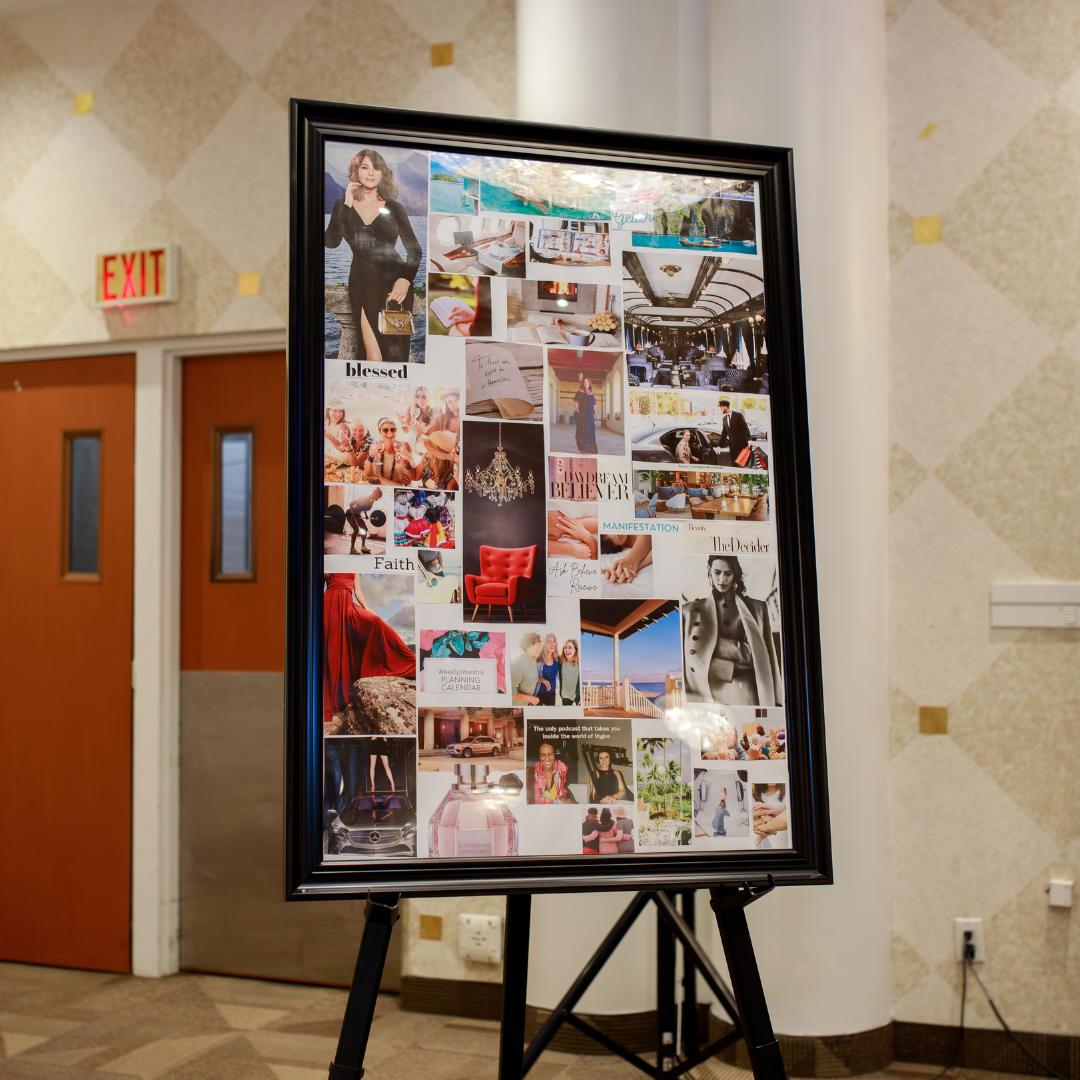
Step 4: Declare (interpret, affirm and share)
Before you share your vision board, ask a trusted friend to interpret it for you. Their perspective can offer unique insight into your choices and even new ways to reach your goals. Notice the colours you chose and look for patterns. They often reveal more than you expect.
Next, choose the vision that makes your knees weak. Create an affirmation for it, and for one or two of your other visions too. An affirmation is a positive statement written as if you have already achieved your vision. Keep it specific and brief, like "I am confidently leading my own workshops," and repeat your affirmations out loud every day for 30 days.
Finally, place your vision board somewhere easy to see, so you can look at it and reflect at least twice a day, and so your trusted community can see it too. The more often you declare your vision, the more energy you put behind it, and the more pathways open up for it to come to life.
Want people to declare your vision to? When you create your board in one of my virtual workshops, you share it with a community who will cheer you on. Join the next virtual vision board workshop here.
Step 5: Dare to Dream Bigger (action and accountability)
This is where your vision board goes from inspiring to life-changing.
Invite an accountability partner. If they have a vision board of their own, even better. You can keep each other on track and celebrate every manifestation together.
Take daily action. In a daily planner, write down five actions you took toward your vision that day. No matter how small, record them. At the end of each week, look back to see who or what you need to follow up on, and celebrate your successes. Feel all the good energy flowing from those actions.
Reflect and stay open. Look back at your board often to see which areas are manifesting. Be open to surprises, because what shows up is often bigger and better than anything you could have imagined.
I always remind people that the Law of Attraction has the word action tucked right inside it. We need to ask, believe, and be ready to act and receive.
And remember, your vision board isn't meant to last forever. Most boards run their course in 12 to 18 months. When yours does, celebrate what showed up and create a new one.
Common vision board mistakes
Most boards that "don't work" fail in one of these predictable ways:
1. Picturing what you don't want. Your board should show what you want, never what you are avoiding. Words matter here. A board that says "debt free" keeps your eyes on debt; a board showing what financial freedom looks and feels like pulls you forward.
2. Choosing the "how" instead of the feeling. A storage system is a how. The calm, peaceful room is the vision. Always choose the image that carries the feeling.
3. Letting "should" pick your goals. If an image feels like an obligation, it does not belong on your board, no matter how sensible it sounds.
4. Overcrowding the board. Overlapping images and zero white space turn a vision into visual noise. Edit ruthlessly and give every image room to breathe.
5. Hiding it away. A board in a closet is a wish in the dark. It needs to be seen, at least twice a day.
6. Making it, then taking no action. The board focuses your attention; your daily actions do the rest. Ask for what you want, believe it is possible, know you are worthy of it, and be open to receive, then move.
Vision board questions, answered
Do vision boards really work?
A vision board works the way a map works: it does not move you, but you are far more likely to arrive when you can see the destination. The board gives you clarity about what you want, keeps it in front of you daily, and prompts the small, consistent actions that actually change a life. My teaching is simple: ask for what you want, believe it is possible, know you are worthy of it, and be open to receive. Then act. I have watched this process work for thousands of people, and I have lived it myself.
What should I put on my vision board?
Images and words that represent what you want across the key areas of your life: your health, relationships, work or business, money, home, travel, personal growth and faith. Choose the feeling, not the "how." Add a photo of yourself from a happy time.
How big should a vision board be?
Big enough to be seen from across the room. The size of your board says something: it represents a bold vision. Small and hidden makes a small statement.
Where should I put my vision board?
Somewhere you will see it at least twice a day: a bedroom wall, your office, inside the door you open every morning. Seen daily, it keeps working. Hidden, it stops.
How often should I make a new vision board?
I suggest making a new vision board every 12-18 months.
Want these five steps in a free guide you can keep beside you while you create? Download "5 Steps to Creating a Powerful Vision Board" and walk through the process at your own pace.
Create your 2027 vision board with me
You probably found your way to this post because you feel like you're meant for something more. I know that feeling: the pull toward something bigger, without fully knowing what it is yet or how to get there.
These five steps are a powerful start, but there's nothing quite like being guided through them. In my virtual vision board workshops, I lead you through every step, from the clarity exercises to declaring your vision, alongside a community dreaming big right beside you. You'll leave with a finished board and a clear direction for your life.
Save your spot in an upcoming virtual vision board workshop.
With belief in your vision,
Debbi Sluys